Ask which AI model is "winning" and you will get a different answer depending on who you ask and where they hang out. Benchmarks measure one thing, download charts another, and the loudest voice on your timeline a third. So we tried a fourth lens: the conversation itself. What are people actually saying about these tools, where, how do they feel about them, and what is each one known for?
We pointed Babel42 at five names that dominate the AI chatter right now: ChatGPT, Claude, Grok, Gemini and Cursor. It listened across four very different rooms, X, Bluesky, YouTube and Hacker News, scoring a broad cross-section of public posts for sentiment and sorting them by theme. This article is what came back, and the short version is that "winning" depends entirely on which scoreboard you read.
One thing before we start. The sentiment scores here are produced by Babel42's AI, and like all automated sentiment analysis they are an estimate rather than a verdict, so treat the percentages as directional. More on that, and on what a sample can and cannot tell you, in the methodology notes at the end.
The volume illusion: Grok is everywhere, and that means less than it looks
If "winning" just meant raw mentions, the story would be over before it started. On X, one name swamps the rest.
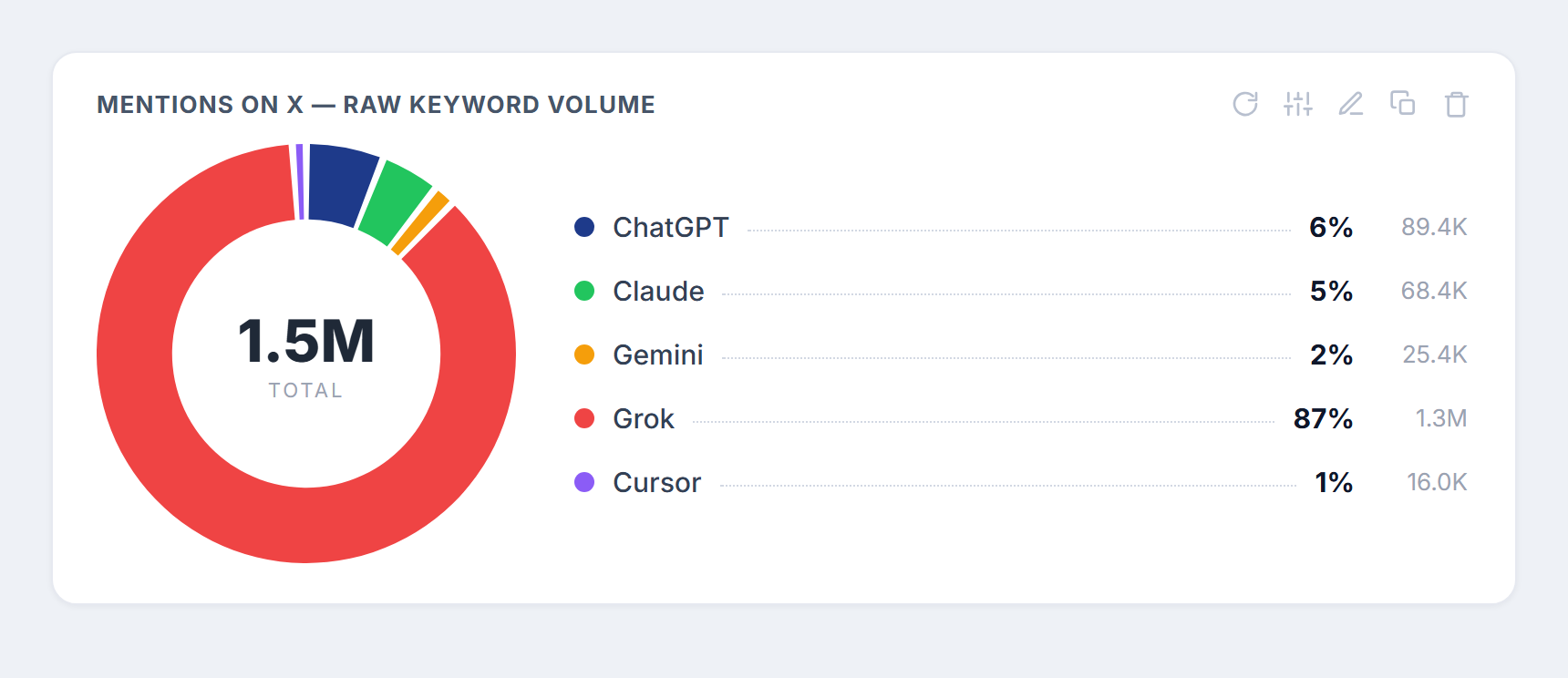
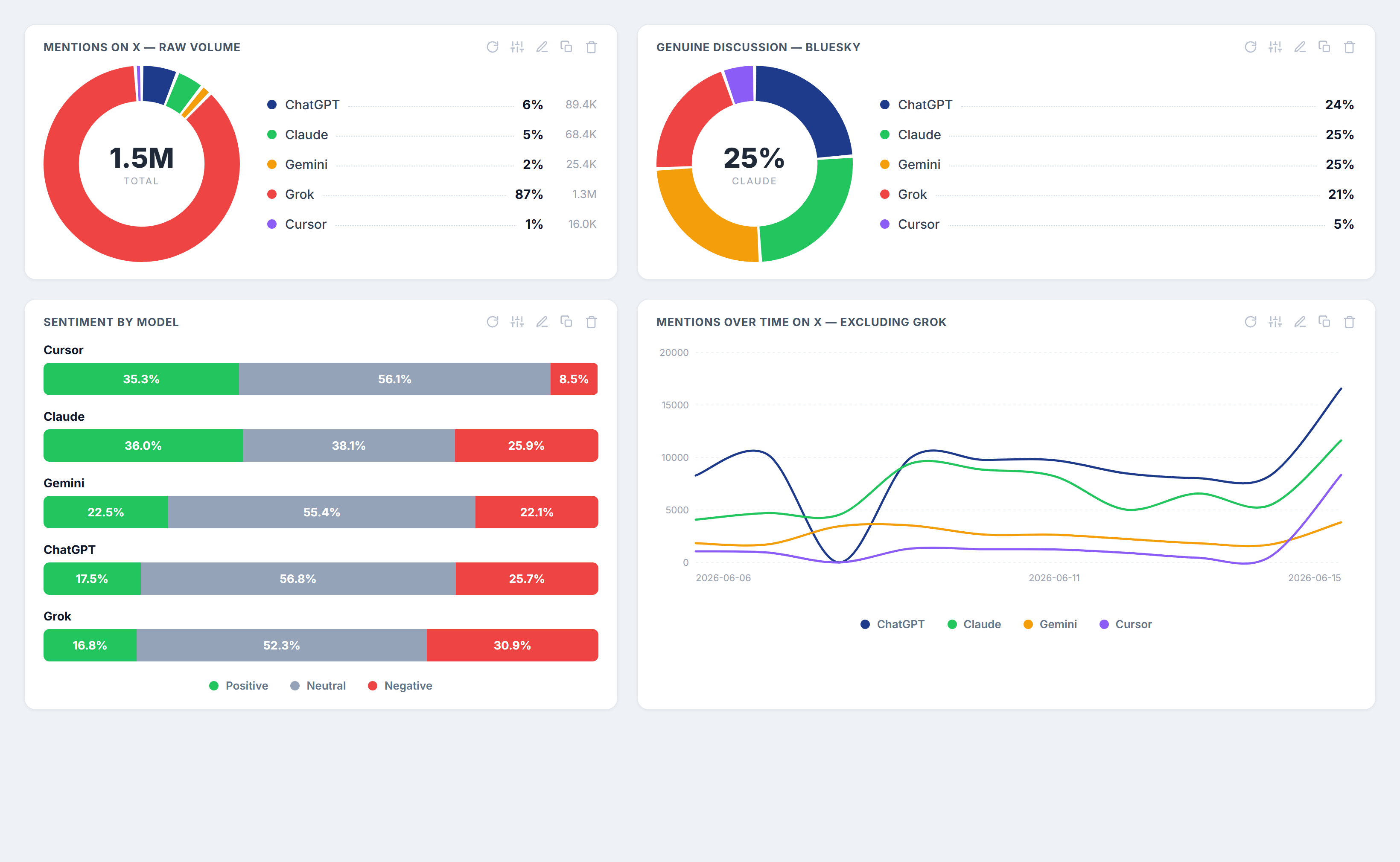
Grok takes the overwhelming majority of X mentions, with everything else fighting over the scraps. But this is exactly the sort of number you should not take at face value. A large share of those Grok mentions are not people discussing Grok at all, they are people talking to it, replying to a post with "@grok is this true?" to summon the bot as an instant fact-checker. That is a real and genuinely interesting behaviour, and we will come back to it, but it is a usage reflex, not a popularity verdict, and it inflates Grok's raw count far beyond the actual debate about the product.
One honest caveat before you read too much into the rest of that chart. These are raw keyword counts, and four of the five names are everyday words, so we had to pair them with disambiguating terms ("Claude" with "Anthropic" or "AI", and so on) while "ChatGPT" needs no such help. That deliberately suppresses the four common-word models, so once Grok is set aside, treat the order below as indicative, not exact, with ChatGPT's lead in particular flattered by its cleaner query.
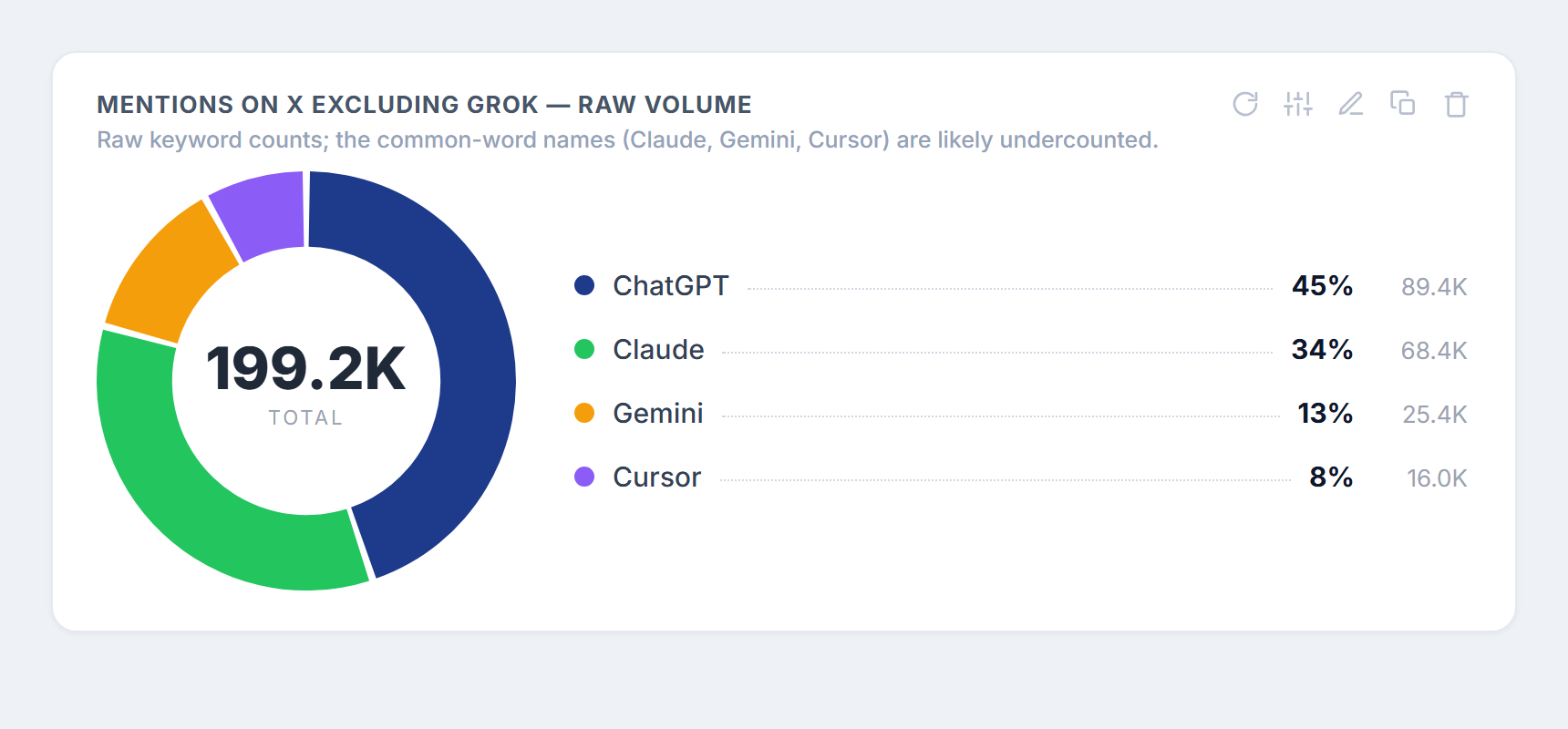
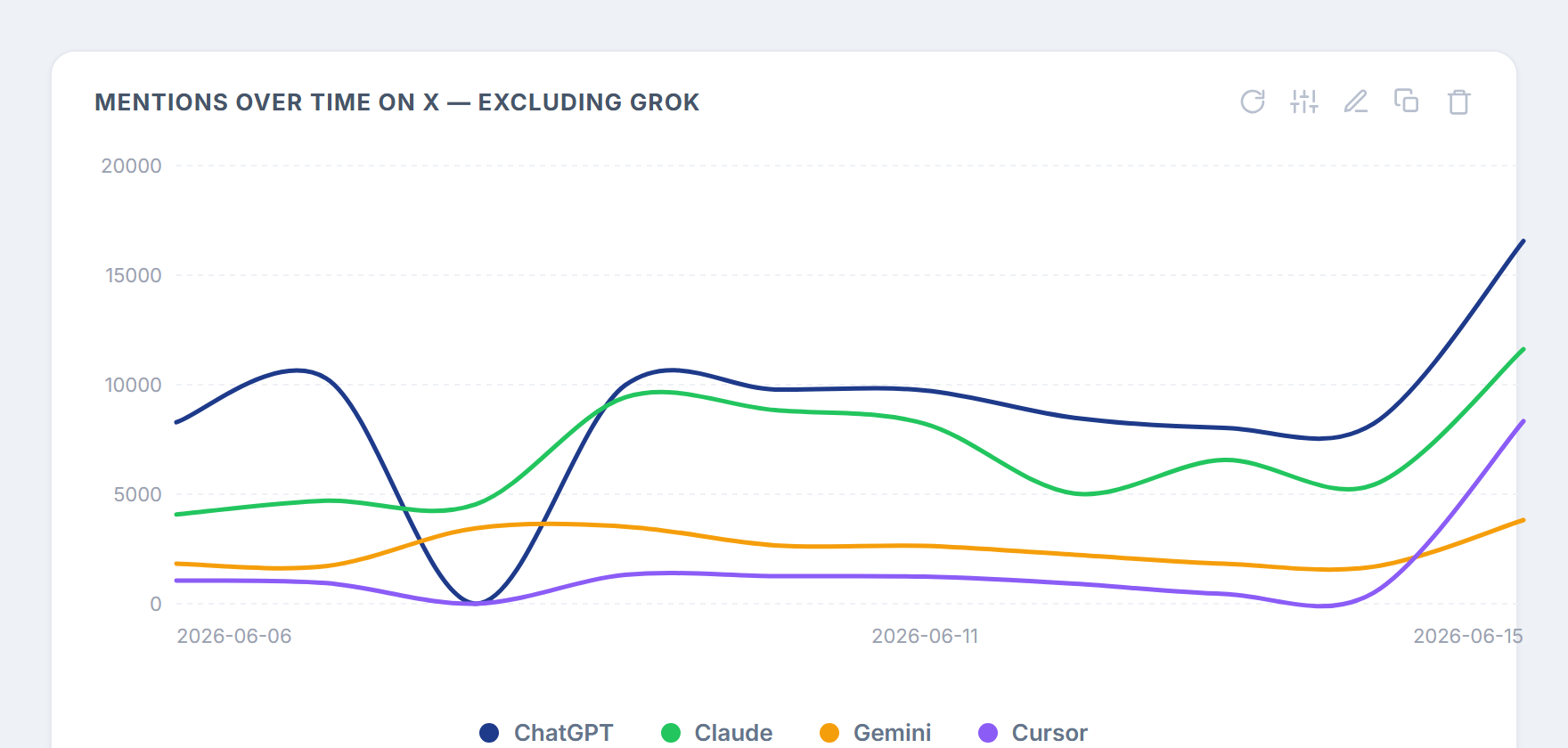
With that in mind, ChatGPT and Claude are clearly the names that surface most on X beyond Grok, and the day-to-day movement is real: ChatGPT climbed steadily through the window we watched.
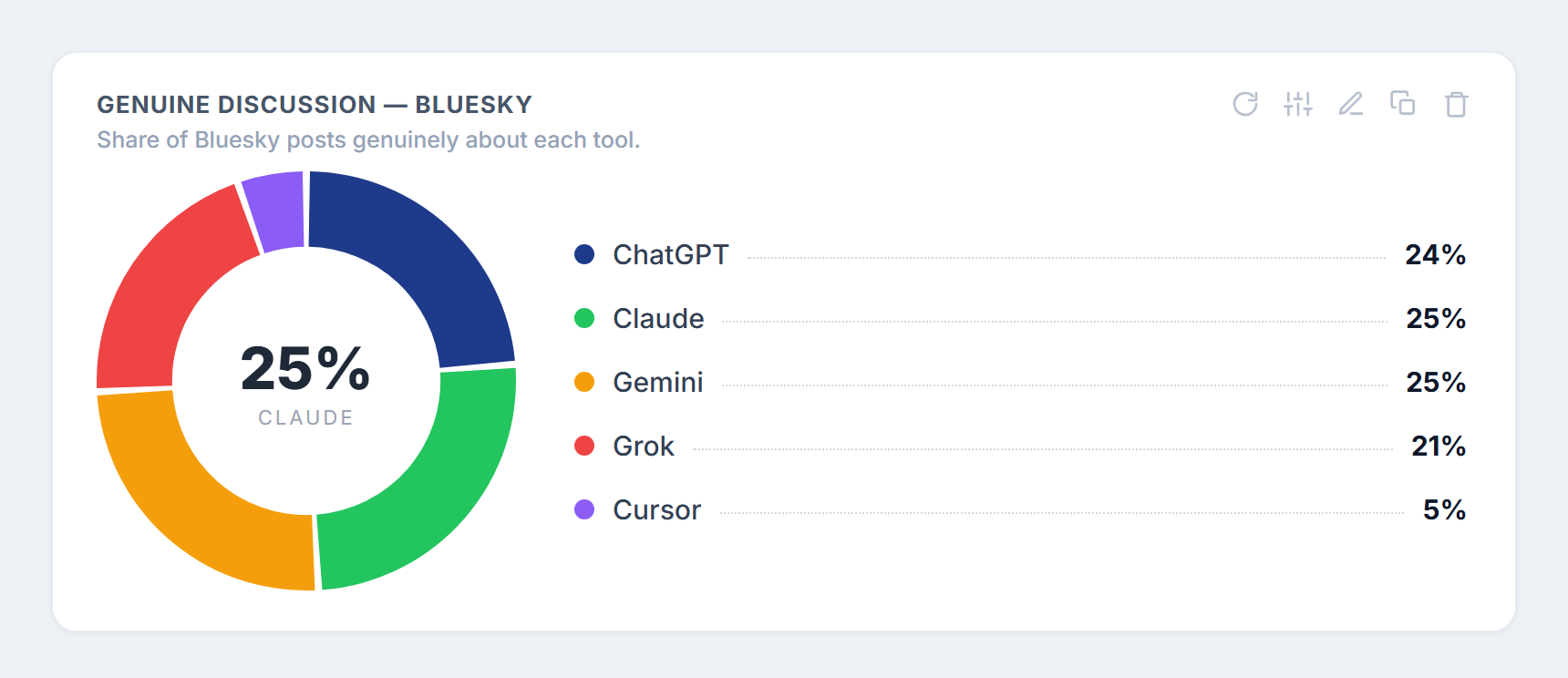
For a cleaner read on genuine relative interest, leave X's noisy firehose for the rooms where people discuss tools rather than summon them, and where we can confirm each post is actually on-topic. The order of finish changes again. On Bluesky, the genuine conversation is led not by ChatGPT but by Claude and Gemini, neck and neck, with ChatGPT just behind, Grok a clear presence and Cursor a niche interest.
On Hacker News, the developer forum, Claude's lead becomes a landslide, taking close to half of the on-topic conversation, with ChatGPT next, then Cursor and Gemini, and Grok barely registering.
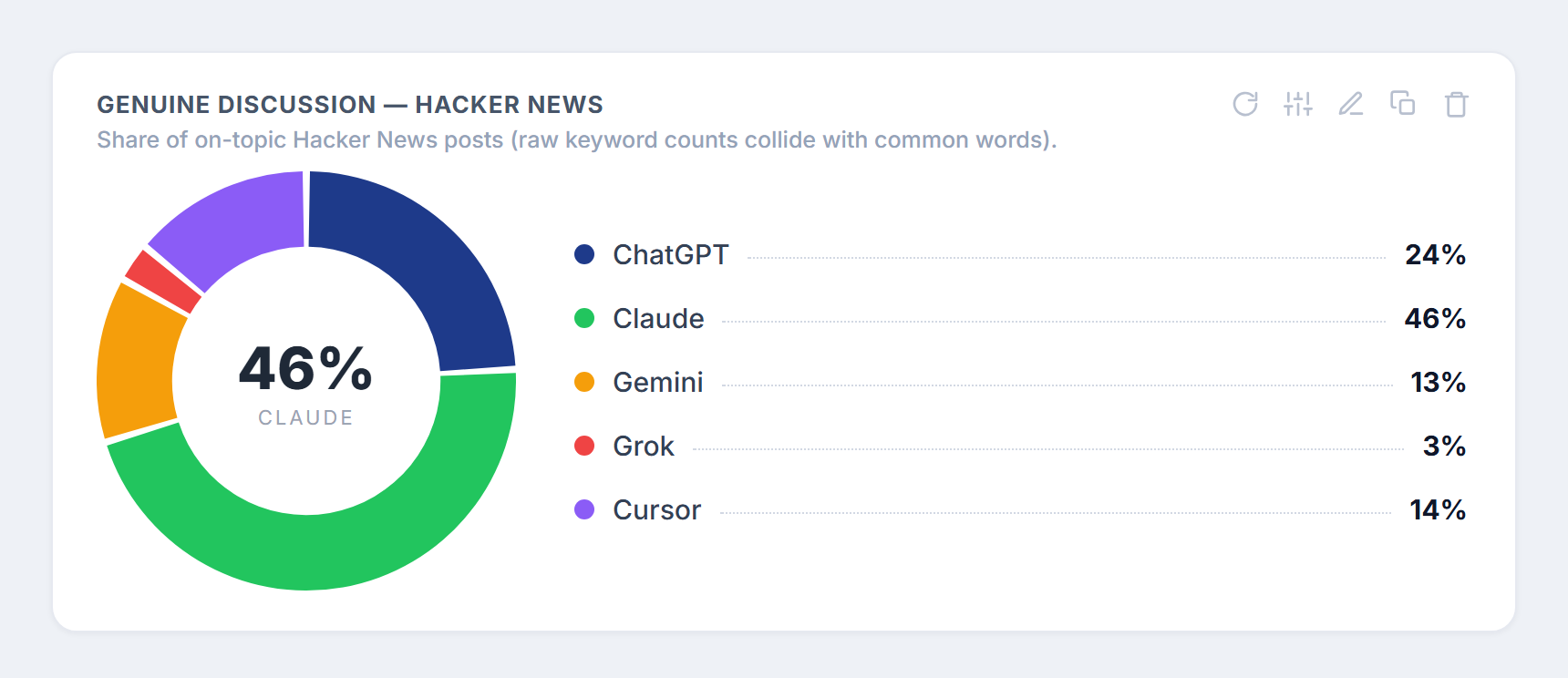
A note on that Grok sliver, because it matters for how you read any social-listening number. A naive keyword count would have told you Grok was huge on Hacker News, but most of those "hits" were the everyday word, "grok" meaning to understand, plus near-misses like "grads". When we filtered to posts genuinely about the product, xAI's Grok almost vanished from the developer forum, scraping just a few per cent. It is not a tool developers discuss; it is a tool the wider public talks to. That gap, loud everywhere it is summoned, near-silent where engineers compare notes, is one of the most revealing things in the whole dataset.
Sentiment: who is actually liked
Volume tells you who is being talked about. Sentiment tells you whether that is a good thing, and here a clear pecking order emerges.
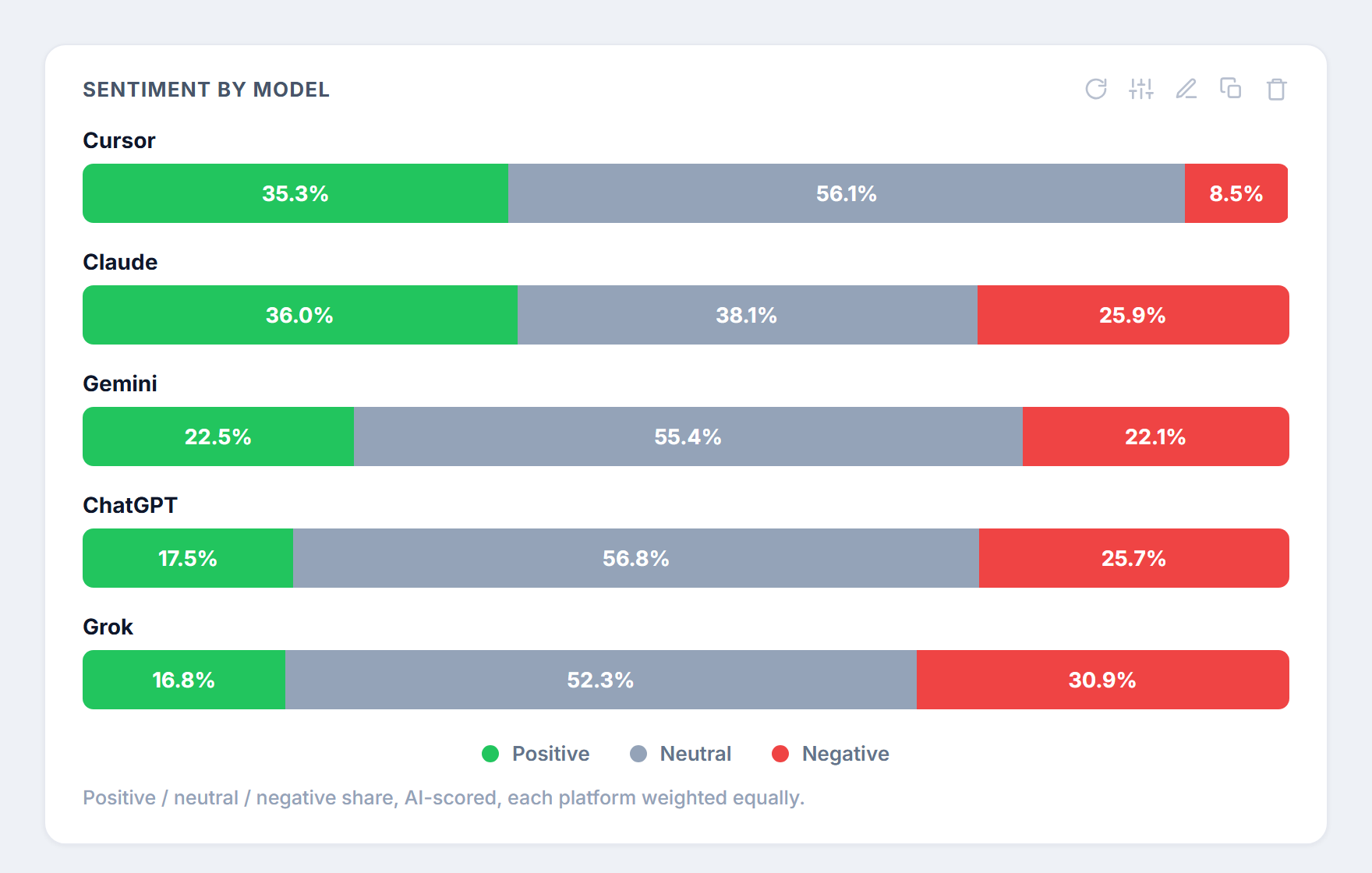
| Model | Positive | Neutral | Negative | Net |
|---|---|---|---|---|
| Cursor | 35% | 56% | 9% | +27 |
| Claude | 36% | 38% | 26% | +10 |
| Gemini | 23% | 55% | 22% | 0 |
| ChatGPT | 18% | 56% | 26% | −8 |
| Grok | 17% | 52% | 31% | −14 |
These are equal-weighted across the four platforms, so a firehose like Bluesky counts no more than a quieter room like Hacker News.
Cursor is the most warmly received tool in the set, with positive posts outnumbering negative ones by close to four to one. It has the smallest footprint of the five, but the people talking about it are, on balance, fans. Claude is a clear second, and does it at far higher volume, the rare combination of widely discussed and genuinely well-liked. Gemini sits roughly neutral.
The surprise for many readers will be the bottom two. ChatGPT and Grok both come out net-negative. For ChatGPT, the most-used AI on earth, that is the price of ubiquity: when everyone uses a thing, it absorbs everyone's complaints. For Grok, it is something sharper, and to understand both you have to stop asking which model people like and start asking where they are standing when they say it.
The same five tools, four very different rooms
Sentiment toward AI is not really a property of the model. It is a property of the room.
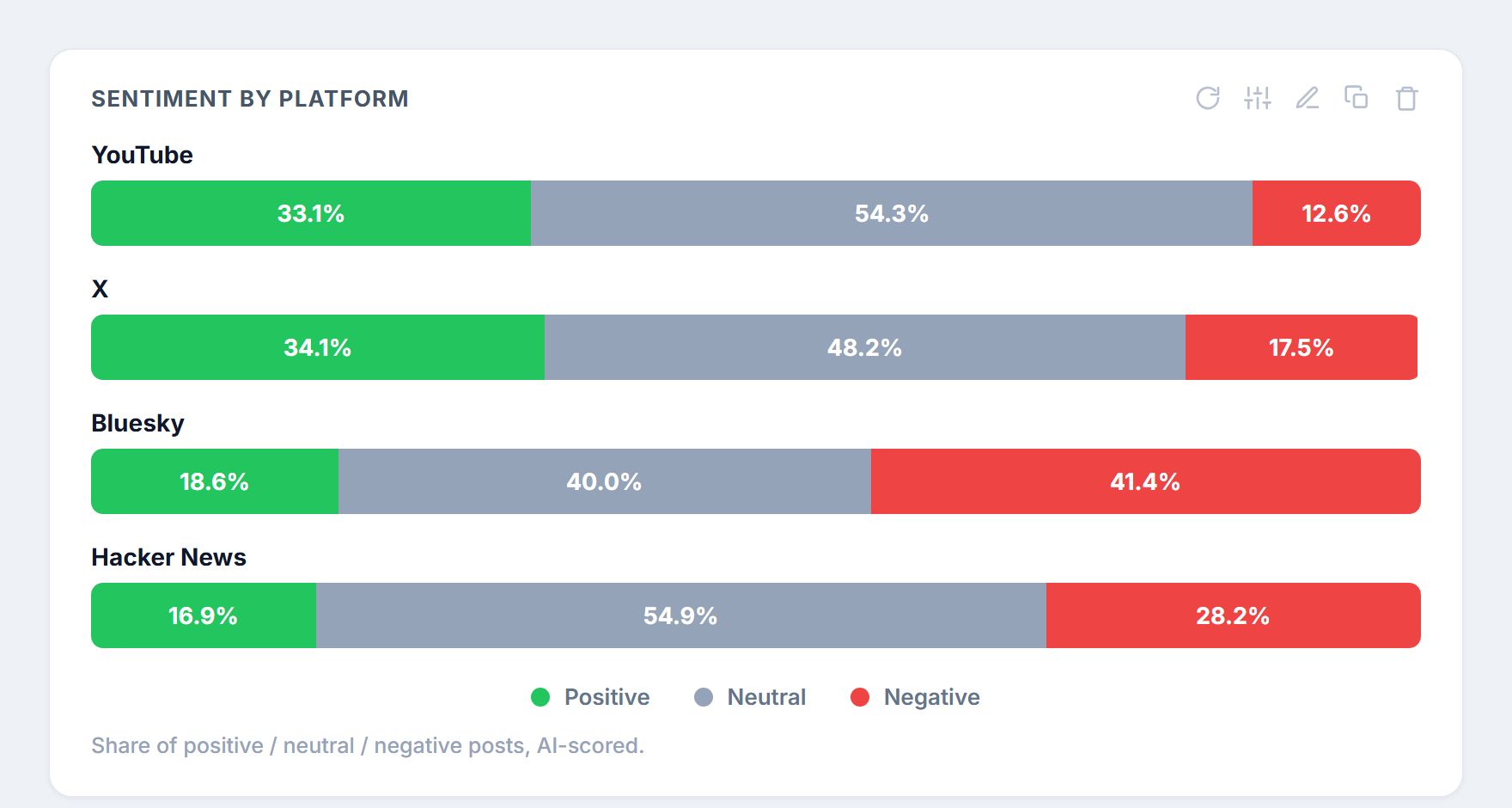
- YouTube is the cheerleader, the warmest room of the lot, full of demos, tutorials and "I tried it and here's what happened" enthusiasm. Creators have every incentive to be excited, and titles like "Grok Imagine 1.5, I tested it" or "Claude Code is a cheat code" set the tone.
- X leans positive too, once you set aside the neutral bot-summoning traffic, with genuine advocacy threaded through the pile-ons.
- Hacker News is cool and exacting. Developers kick the tyres hard; the conversation is less "wow" and more "Visa is letting ChatGPT agents make payments" or "cybersecurity researchers aren't happy about Claude's guardrails". Scepticism is the house style.
- Bluesky is openly hostile to AI, the only room where negative posts outnumber positive ones two to one. This is where the backlash lives: criticism of AI "slop", of energy use, of safety failures, of the whole enterprise.
Slice the same tools by room and the spread is the real story. Net sentiment (positive minus negative share) for each model, by platform:
| Net sentiment | X | Bluesky | YouTube | Hacker News |
|---|---|---|---|---|
| Cursor | +40 | +7 | +29 | +32 |
| Claude | +27 | −4 | +45 | −27 |
| Gemini | +13 | −10 | +6 | −7 |
| ChatGPT | −7 | −37 | +16 | −4 |
| Grok | +8 | −53 | +3 | n/a |
Look along any row and the point makes itself: Claude swings from +45 on YouTube to −27 on Hacker News, an enormous gap for the same tool in the same fortnight. (Grok's Hacker News cell is left blank because too few genuine posts about it surfaced there to score fairly.) The single "who is liked" figure earlier is an average of these very different rooms, not a fixed truth.
The effect on individual models is dramatic. Grok is mildly positive on X, the platform it was born on, but savaged on Bluesky, where it draws the harshest treatment of any tool in our sample, much of it serious criticism around safety and harmful image generation rather than idle grumbling. Claude is adored on YouTube and X but gets a noticeably cooler reception from the tough crowd on Hacker News, who hold the tool they rely on to the highest standard. Cursor is the only tool that stays net-positive in every single room, and it is the rare AI product the famously hard-to-please Hacker News crowd actively likes.
Read only YouTube and every model is a marvel. Read only Bluesky and the entire field is a disaster. The truth sits in between, which is the whole case for listening across platforms rather than trusting whichever one you happen to live on.
What each model is actually known for
This is where the personalities separate, and it is the most useful chart in the piece. We grouped every post by what it was about, and the five tools occupy strikingly different territory.
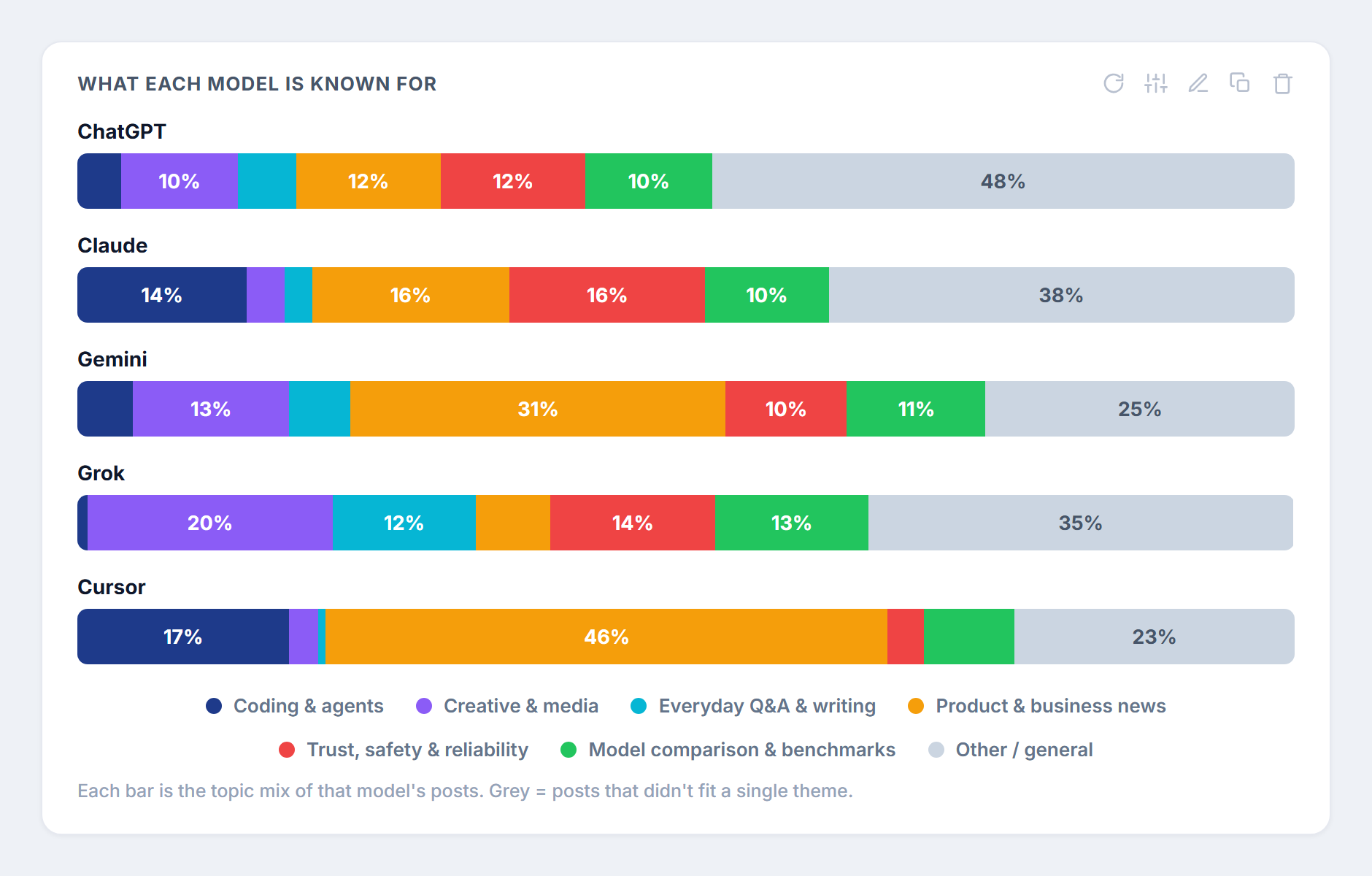
- Cursor is the vibe-coding tool. Its single biggest theme was actually product and business news, pricing shake-ups, enterprise controls and a loud swirl of takeover speculation, but the thing it is known for is unmistakable: the most common specific topic attached to it is "vibe coding", describing what you want and letting the AI write the software. One developer's widely shared post caught the mood: "Cursor still blows my mind daily, I gave it a ten-minute voice note, went to eat dinner, and came back to a shipped landing page." It barely appears in any other context, which is exactly what a sharp, single-purpose reputation looks like.
- Claude is the professional's model. Its conversation splits between serious coding, product and business news, and a heavy strand of trust-and-safety talk, model releases, guardrail debates and security-vulnerability threads. It is the tool people reach for when the work is real, which is exactly why it dominates Hacker News and why that same audience holds it to a higher standard.
- ChatGPT is the everyman. No single theme dominates, which is the point. It shows up in image generation, content creation, pricing chatter, comparisons and everyday use alike, even in stories about AI agents being handed payment cards. It is the broad default that turns up everywhere and specialises in nothing, because it does not have to.
- Grok is the answer machine and the image engine. Its conversation leans towards image and video generation and that "@grok, settle this" fact-checking reflex, with a darker thread of safety and content-moderation controversy running underneath. People use it to ask and to make, more than to discuss.
- Gemini is the platform play. A big slice of its conversation is product and ecosystem news, talk of where Google is putting it next and which devices it is arriving on, alongside a strong strand of image generation. People discuss Gemini less as a model they have chosen and more as a feature landing in things they already use, which helps explain its flatter, more neutral sentiment.
If you are trying to place these tools, the data sketches three rough camps. There is everyday assistance, where ChatGPT and Grok live, the tools the general public reaches for to ask, write and make. There is serious building, where Cursor and Claude have planted flags, the developer-and-professional end where work gets done and reputations are won or lost on Hacker News. And there is the platform layer, where Gemini sits, talked about less for what it is than for where Google is shipping it next.
What we would take away
- Loudest is not the same as winning. Grok's enormous X footprint is real, but a large slice of it is people using it as a fact-checking reflex rather than debating its merits. Strip that out and the race is far closer, and on the platforms where people genuinely discuss tools, Claude leads.
- The best-liked tools are the focused ones. Cursor and Claude top the sentiment table, and both have sharp, legible identities. The broad generalists, ChatGPT and Grok, pay for their reach with more divided, and more negative, opinion.
- Sentiment is a room, not a fact. The same tool can be a hero on YouTube and a villain on Bluesky. If you monitored only one platform, you would badly misread the mood, which is the entire argument for listening everywhere at once.
- Reputations are already specialising. Cursor owns vibe coding, Claude owns serious work, ChatGPT owns everything-and-nothing, Grok owns the quick answer and the image, and Gemini owns the Google ecosystem. The market is sorting itself into lanes faster than the marketing is.
How we did this, and the caveats
We ran Babel42 monitors on each of the five tools and listened across X, Bluesky, YouTube and Hacker News, scoring a broad cross-section of public posts for sentiment and tagging each by theme. To keep the comparison fair we filtered out off-topic keyword matches, the everyday "cursor", the astrological "Gemini", "grok" used as a verb, before anything was counted, which is why a couple of the figures look very different from a naive keyword count. After that filtering, the on-topic samples ran from several hundred posts (YouTube and Hacker News) to over a thousand (X), with Bluesky trimmed to a comparable size, a few thousand posts in all.
A few honest limits:
- Sentiment is scored by AI, and AI sentiment analysis is not perfect. Sarcasm and hype both trip it up, and the AI world runs on both, so read individual scores as estimates and the aggregates as directional.
- A sample is a window, not a census. The real conversation is far larger than anything we read, so we make no claim about total volume on the sentiment and theme splits; they describe the cross-section we analysed.
- We weighted every platform equally when comparing models. Bluesky is a firehose and skews heavily negative, so rather than let its volume decide the verdict, we gave each room the same weight: a model's score is the average of how it is received on X, Bluesky, YouTube and Hacker News, not a simple pooled tally.
- The X figures are raw mention volume, not share of voice. Because four of the five names are common words we paired with disambiguating terms while "ChatGPT" needed none, the non-ChatGPT models are undercounted on X. So we treat the X split as indicative only, and read genuine relative interest off the platforms where every post is verified on-topic.
- English-language only. We sampled English posts, so this is the anglophone conversation, not the global one; sentiment toward these tools may look different in other languages.
- A single ten-day window, and not a precise instrument. Sentiment especially is shaped by that fortnight's news, and several per-platform samples run to only a few hundred posts, so treat gaps of a few points as noise rather than signal. As we widened the sample during the analysis, some figures moved by double digits, which is the honest level of precision here.
- Some of the chatter is about events, not the tools. A swirl of takeover speculation, model releases and partnership rumours runs through the data; we have reported it as what people were talking about, not as established fact.
Frequently asked questions
Which AI model is talked about most? By raw volume on X, Grok dominates, though much of that is people tagging it to fact-check posts rather than discussing the product. On the platforms where people genuinely discuss tools, the conversation is led by Claude, overwhelmingly so on Hacker News, with ChatGPT, Gemini and Cursor filling out the field behind it.
Which AI tool has the best sentiment? In our sample, Cursor had the most positive reception, ahead of Claude. Gemini landed roughly neutral, while ChatGPT and Grok both came out net-negative once every platform was weighed evenly.
What is Cursor known for? Coding, specifically "vibe coding": describing what you want in plain language and letting the AI write the software. It has the sharpest single-purpose reputation of the five tools we looked at, and the highest sentiment.
ChatGPT vs Claude: which is better received? Claude, clearly. It drew a higher share of positive sentiment and a stronger net score, and it dominates the genuine conversation on developer platforms. ChatGPT attracts a far wider, and more divided, spread of opinion as the mass-market default.
Why is sentiment toward AI so different on Bluesky? Bluesky has become a centre of AI scepticism, and in our sample it was the most hostile room of the four, the only one where negative posts ran roughly two to one over positive ones. The criticism focused on AI "slop", energy use, safety and the ethics of the technology, in sharp contrast to the enthusiasm on YouTube.
Why does Grok have negative sentiment if it is so popular? Grok's huge volume comes mostly from X, where it is used as a fact-checking bot. When you look at how people actually talk about it, especially on Bluesky, the tone turns sharply critical, with a heavy focus on safety and content concerns, which drags its overall sentiment down.
See it for your own brand
Everything above, the share-of-voice splits, the AI sentiment scoring, the platform comparison and the theme detection, came from Babel42 monitors that took a couple of minutes to set up. Swap these five AI names for your brand, your competitors, your category or the next thing everyone is arguing about, and you will get the same depth on the conversations that matter to you.
Babel42's free plan includes monitors, AI sentiment analysis and multi-platform coverage, with no credit card and no sales call. Start listening today, for free, and hear what the internet's really saying about the tools, and the brands, you care about. New to the idea? Start with what social listening actually is.